Thursday, December 03, 2009


It was Round 4 of the Bergen Chess Mates club championship held in Ridgewood, New Jersey. The club used to be known as the Dumont Chess Mates, but after it moved from Dumont to Ridgewood a name-change was necessary. The club met on Monday nights for forty years at the cafeteria of the Dumont High School, but it only took an unsympathetic school official to kick us out of there. We're quite happy at our new site, the United Methodist Church. The church offered their basement area for our purposes, and now we have a tournament room, a skittles room, a receiving room, and a living room that doubles as the local AA meeting room. We're just dandy!

Anyway, at this point of the game, I could either take the pawn at a5 and get my opponent's knight at the edge. That would cost him another tempo just to get his knight back into the frey. Or, I could advance my queenside pawns, and move up my king in support. The black knight would spend several tempi just to get at my pawn on a2 before black could make threats over in that area. So, I thought for a while and settled on a move my opponent didn't see coming... from the position above, 1. f5+ . Fritz9 advised to take the pawn on a5, like 1. ba Na5 2. g6 Nc4 3. Nd6... Anyway, I thought my move was good as well. Play continued 1...Kf5 ( making life easier for me )2.Nd6+ Kg5 3. Nc4 bc4 4.ab and black resigned.


Saturday, September 26, 2009

Although there was still a lot of play ahead, I felt that white's position was losing to black's and I needed some good counterplay before black's A & B pawns became a real problem. Post game analysis with Fritz9 also assessed the position as good for black. So, I played 27. g5 to create some targets and counterplay. In fact, Fritz9 recommended this move for white. Black, already a pawn up and in the throes of a strong queenside attack, could have maintained the pressure by simply playing 27... Qc4 or 27...h5. But, no. He had to grab the pawn! This pawn-grab initiated a series of forced moves that led to his demise. After 27... hg5?, the attack commenced with 28. Rh3 ( threatening mate on h7 ) g6 ( forced ) 29. Qc3 ( threatening mate on h8 ) f6 ( forced and covering the diagonal ) and then the very lovely sacrifice 30. Rh8+ and black resigned with a mate in two coming.


Tuesday, August 25, 2009

I was thumbing through some of my chess books, and I found this sweet endgame study whose underlying principle should be basic knowledge for every chessplayer. There are no fancy moves here, just straight-forward positional play. It's the kind of position that you'd enjoy practicing against Fritz. White to move and win.

Wednesday, August 12, 2009

If you were black, would you simplify or not? After some exchanges, as white, I came out a piece up and it looks like a decisive advantage. That's why I sought an exchange of queens, and black seemed to see it that way as well. Black played Qa6, attacking my rook and avoiding further simplification. Now, I am not so dull as to miss the three connected passed pawns on the queenside. With the exchange of queens and some accurate play, I should be able to stop those pawns that are still in their initial squares. But to win that way is a lot more work than what happened in the game. Black's move, Qa6, allowed white to gain tempo for an attack that would not have been possible if the queens were exchanged. Play continued after Qa6 with Bh7+ Kh8 Re3 g6 Bg6 fg6 Qg6 and black was lost.

Tuesday, July 21, 2009

This was black's French Defense gone awry, having allowed white a decisive space advantage on the kingside with all of black's pieces bottled up behind a wall of pawns, including the proverbial bad bishop. Black made a dash for freedom with 29...Ra8-Rd8 (diagram). The object, of course, is the pawn on d4 after the rook takes the bishop on d6. Black gets some counterplay once his queen penetrates into white's position. But I had some tricks of my own, and sprung 30. Bf5 on my opponent. My opponent concentrated on which pawn to capture my bishop with that he missed a better reply in 30... Nd4, a sac of his own. Taking my bishop with 30... ef5 makes 31. Qd5+ possible and white will win 31...Qf7 32. Rg6+. So, he took with the G pawn, 30...gf5, and expected 31. Re6 in return. However, the h5 square is now undefended and I played 31. Qh5 instead. This was the winning move. The game went 31... Rd6 32. Qe8+ Qf8 33. Rh8+ Kh8 34. Qf8+ Kh7 and then 35. ed6. 1-0

Saturday, July 11, 2009


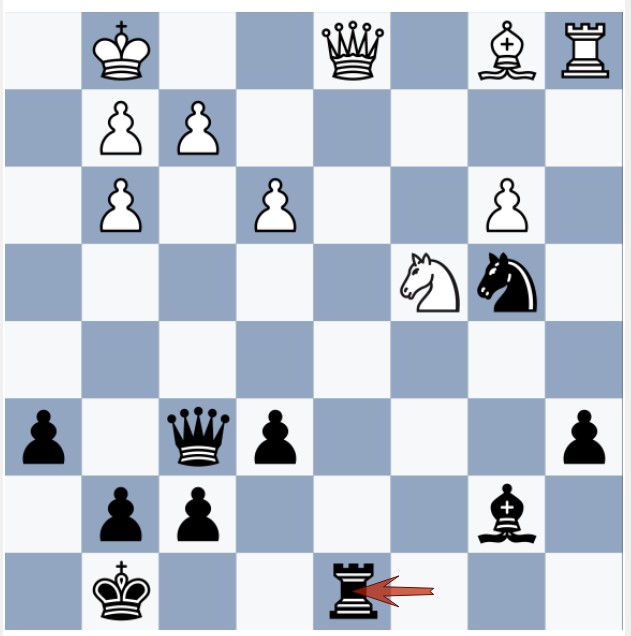
Once in a while you end up with a position that is noteworthy just by dint of its peculiarity. You will see that white is a rook up but his queen and king have become the unfortunate victims of the black rook when he played 36... Rh8. Well, there is a way out. I played 37. Rf7+ Kg1 (forced) and then 38. Ra8+ wins it for white even after 38...Qb8. My king and queen remained skewered by the rook.

Tuesday, July 07, 2009


I misplayed this ending, and ended up with a draw. My excuse, it was a blitz game. What else? Sometimes, this rule that we have to centralize our king in the endings gets in the way of a won game. But, it is when to apply the rule or not is what makes chess a game of good judgment. My immediate inclination was to get my king into the action, and I played 42. Kf2? Bad move. The trick here was to push the D pawn immediately where the black king would catch up to it at d7. By then, the bishop can support the pawn while the white king moves up to confront black's G & H pawns. In some variations, there are themes of zugswang. The pivotal point here is that black's king is tied down to the defense of D8, and his counterpart is free to roam.